
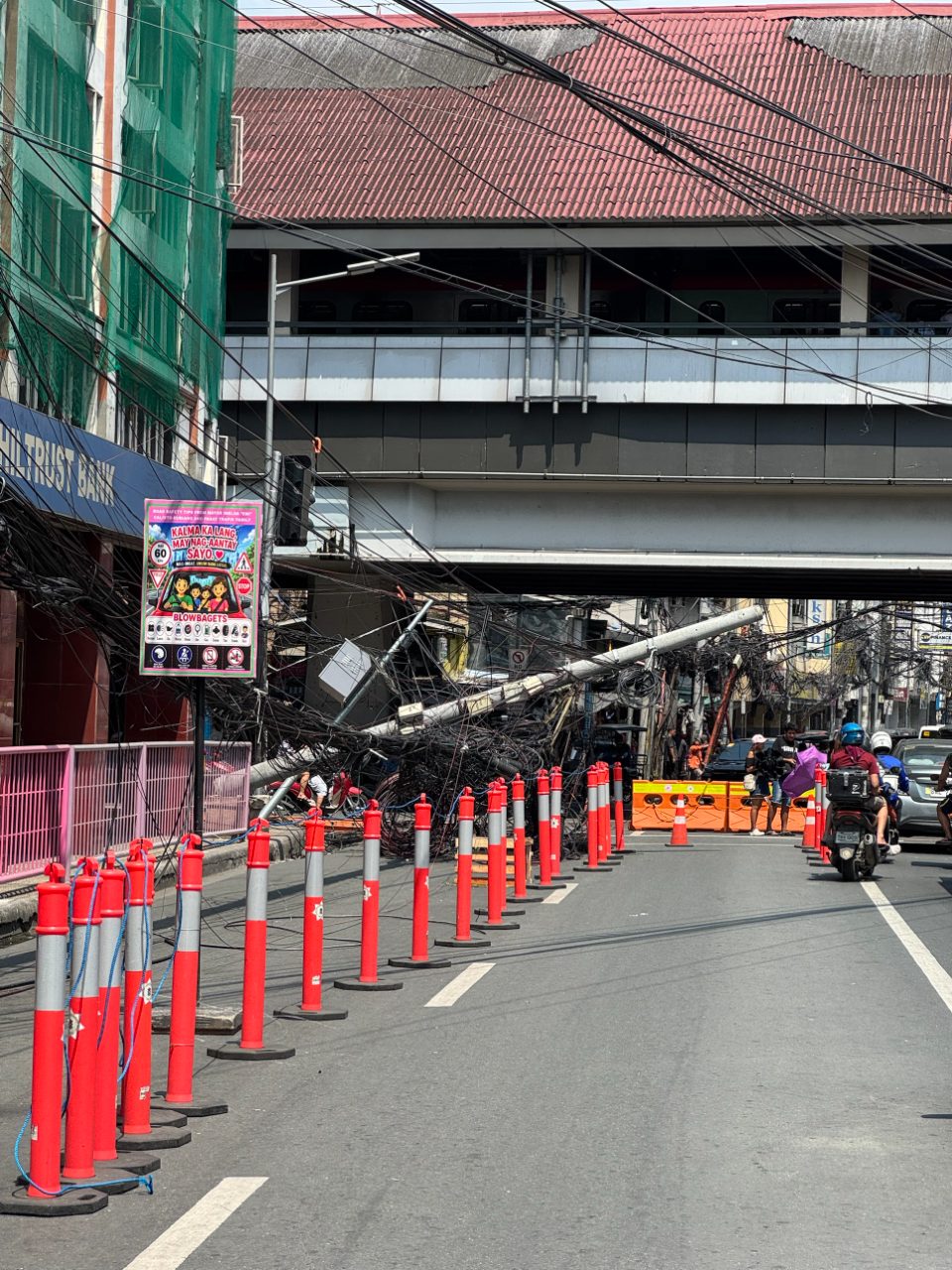
At the Scene: A Utility Pole Lying Sideways
While walking around A. Libertad Street in Pasay City, I unexpectedly came across a utility pole that had fallen right over from its base. Countless electrical and telecommunications cables were still wrapped around it, extending into the road, while red-and-white bollards cordoned off the area. This happened beneath an elevated LRT/MRT line, on a street that sees a fair amount of traffic.
Fortunately, nobody nearby appeared to be injured. Still, the sight was unnerving when I imagined that whole mass of cables coming down together.
What Exactly Are These “Spaghetti Wires”?
Walk around a Philippine city and you will often see a dense, tangled mass of black cables hanging from utility poles. They are not just distribution lines belonging to the power company (Meralco, in Manila). They are the cumulative result of telecommunications providers, cable-TV operators, internet companies and other businesses installing their own cables on the same poles. Because different operators have added lines at different heights and at different times without a consistent set of shared practices, it can reportedly be difficult even for local residents to tell which cables are still in use and which have been abandoned.
They Can Be Dangerous, Too
This is more than a matter of appearances. Local media have reported a number of hazards associated with spaghetti wires:
- Electric shock: There have been cases in which laundry or signage touched a live wire, causing an electrical accident.
- Falling cables during typhoons: Strong winds and the weight of old cables can strain poles and increase the risk of collapse or falling lines.
- Obstructed streets: Sagging cables can block sidewalks, pedestrian bridges and vehicle routes.
- Collapse of the utility pole itself: As in the incident I witnessed.
Manila’s mayor described the city as having as much as “two million kilometres” of wires hanging overhead that were no longer being used or serving a purpose, and pointed to this burden as a contributor to the risk of poles collapsing.
Manila Is Taking the Problem Seriously
Spaghetti wires are recognised as a public issue in the Philippines. In 2024, the Metropolitan Manila Development Authority (MMDA) and Metro Manila Council (MMC) adopted a resolution addressing the problem. Starting in 2025, the City of Manila also launched a campaign ordering electricity, telecommunications and cable operators to remove unnecessary lines. Major power utility Meralco has said that it will continue removing them until the last spaghetti wire is gone. Untangling years of accumulated wiring is now a gradual, ongoing effort.
Final Thoughts
Seeing an entire utility pole lying on the road was certainly unusual. But behind the familiar chaos of overhead wiring lies a deeper problem: years of different companies installing cables without sufficient coordination. It is a sight you can easily become accustomed to when living in the Philippines. During typhoon season, or when walking near an ageing utility pole, it may be worth looking up as well as ahead.
Note: The photographs in this article were taken by the author at the scene. The precise cause of the incident and responsibility for the collapse have not been verified. This article presents what was observed on the street; it does not determine liability.
References